The Bone That Doesnt Break
Connecting the Dots
The doctors said the sacrum is nearly impossible to break. Mine broke — and it turned out to be the most important thing that ever happened to me.
There's a bone at the base of your spine called the sacrum.
The name comes from the Latin os sacrum — the sacred bone. It's thick and low and built to carry the whole weight of you. Ask a doctor and they'll tell you it is one of the hardest bones in the body to break. It almost never happens.
Mine broke.
And for a long time, that was the worst thing that had ever happened to me. I did not yet know it was the best.
I've told the story elsewhere of how that break grounded me — how it lifted me out of the cockpit for good and set me down beside my newborn son. That was the gift I could see right away.
This is the gift I couldn't.
Because grounded is a gentle word for what it actually was. I couldn't sit for more than an hour without the pain finding me. I couldn't work long before it caught me and pulled me down. The man who had crossed oceans at altitude now measured his whole day by how long he could stay upright. The license was gone. The career was gone. The identity I'd been building since I was a boy alone in a small plane before I could legally drive — gone, in a single fall on a hillside.
And here's the part I'm not proud of: I did not take it gracefully. I hated being told to take it easy. Everything in me wanted to push, to fix, to fly. The stillness felt like a punishment.
It wasn't. It was medicine. I just couldn't taste it yet.
Slowly — and slow was the only speed I had left — that forced quiet did something I could never have done on purpose. It brought me back into balance. When you cannot run, you finally look. When you cannot fly, you finally take root.
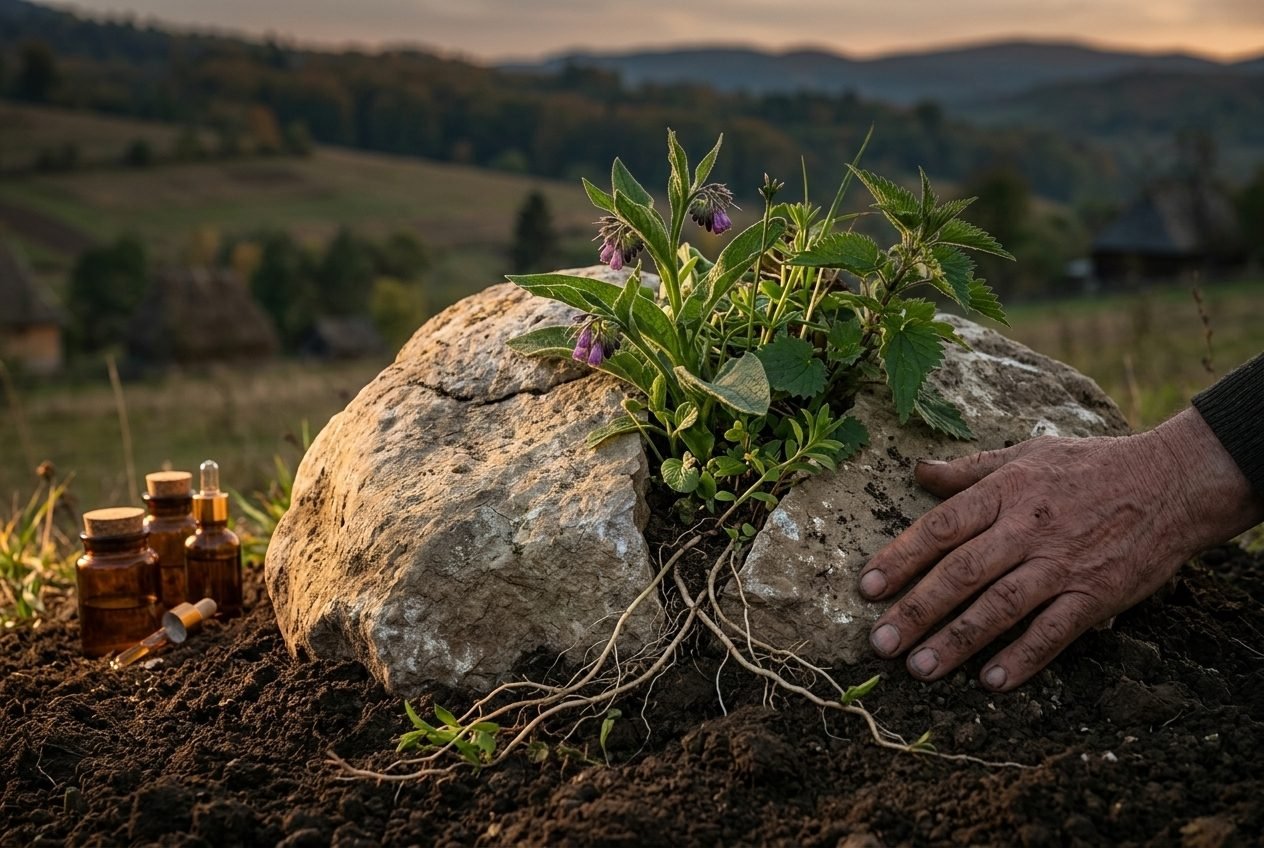
I was living on a windswept ridge in Alaska, the winds howling over a hundred miles an hour, and with all that time on the ground, I went into the woods. I'd started some nature training years before the fall; now, grounded, I went deep. I learned the wild plants — which ones heal, which ones feed. I began to harvest them, to make tinctures, decoctions, infusions. I almost always had something quietly steeping on the stove. My hands, which had held a yoke steady over the Pacific, learned to hold a knife over a cutting board, a root, a length of green wood.
The pilot fell out of the sky. And an herbalist stood up out of the ground.
I'd spend the next twenty-five years becoming a healer — permaculture, plant medicine, the whole Earthway. Everything I now am, everything I have to give another human being, grew straight out of the one injury I would have given anything to avoid. The sacred bone broke — and out of the break came the sacred work.
So here is the dot, and it's for you.
Something is going to break in you. Maybe it already has. A body. A marriage. A career. A plan you had built your whole self on top of. The world will call it a catastrophe, and for a while you will agree with it.
But listen. A breakdown and a breakthrough are often the very same event, seen from two ends of time. The thing that shatters the life you had is frequently the only thing strong enough to crack you open to the life that was waiting underneath it. The wound is not always the opposite of the medicine. In the deepest cases, the wound is the medicine — the exact shape of your breaking turns out to be the exact shape of your gift.
So don't waste the break. Don't spend all of it cursing the fall. Sit in the stillness it forces on you — even when you hate it, especially when you hate it — and ask, quietly, what it is trying to grow in you.
This is the one thing I'll say about the loom. There's an old move I live by, older than any machine: Earth misery into wisdom. You take the raw suffering — the break, the loss, the fear — and you don't bury it, and you don't drown in it. You compost it. You turn it, slowly, patiently, until it breaks down into something that can feed the next thing that grows. That is the real work of a life. And it's the one thing I ask a machine to help me with: not to distract me from the wound, but to help me turn it — again and again, without forgetting — into medicine. Mine. And maybe, one day, yours.
I make salves now, on a hillside in Transylvania, from plants I grow and gather with my own hands. People will come to heal on this land. And not one jar of it, not one guest, not one word of what I'm writing to you now, would exist if a nearly-unbreakable bone had not given way beneath me on a gray afternoon far from home.
The soil keeps regenerating. Nothing is wasted down in it — the fallen leaf, the snapped branch, the dead and the broken, all of it goes down into the dark and comes back up as green. The sine wave turns, and the very bottom of the fall is exactly where the new growth is seeded. Seven generations are watching from the barn — and they were not built by my victories.
They were built out of what I did with my breaking.
Whatever broke in you — don't waste it.
Compost it. Grow the medicine.
Mitakuye Oyasin — all relations.
— Kevin